Traditional keyword research is often a slow, messy process. I’ve spent years merging spreadsheets from different tools, fighting endless duplicates, and questioning whether third-party metrics were even close to reality. Most of the time, you end up with a dataset too noisy to build a confident content plan or a high-performing ad campaign.
To solve this, I developed my own Keyword Clustering & Analysis Tool — a fully automated Python-based pipeline that transforms scattered data into a clean, high-fidelity semantic map.
I built this system to be powered by:
The result is a dataset that reflects my uncompromising approach to technical SEO: it’s incredibly clean, structured, and ready to be used in real-world workflows without any manual cleanup.

Upload a sample: Keyword Research for a Mold Remediation Contractor
My core objective was to automate enterprise-level keyword research while stripping away every manual inefficiency I’ve encountered over the years.
To achieve this, my tool combines two types of input signals:
Once merged, I enrich this entire dataset directly via the Google Ads Data API.
This part is crucial: because my tool pulls raw, first-party metrics directly from Google, it eliminates the inaccuracies and delays inherent in almost all SEO aggregator tools. You’re not working with “estimated volume” — you’re working with the real thing.
A major advantage of my workflow is the proprietary NLP-based normalization engine I’ve built into the pipeline. Its job is simple: to transform a "dirty" list of thousands of keywords into a dataset that is:
To do this, I’ve integrated Python’s NLTK resources, including custom stopword corpora and the WordNetLemmatizer. During initialization, my script loads these libraries to filter out non-informative terms and normalize keyword variations. This ensures that morphological differences (like "running" vs. "runs") don't clutter your report.
I apply three strict filters to ensure we only focus on what moves the needle:
This is where the "heavy lifting" happens. I designed this stage to solve content cannibalization before it even starts:
By the time the data reaches the final report, every keyword represents a unique meaning and a unique search intent.
I believe that not all clusters are created equal. To save you from guessing, my tool ranks every cluster based on a composite priority score that I’ve developed. This score factors in:
This transforms a standard keyword list into a strategic roadmap. Instead of wondering where to begin, you’ll see exactly which content areas will deliver the fastest impact and the highest ROI.
The keyword research package I deliver contains specific data points that typical SEO tools simply cannot provide with this level of reliability.
I provide data pulled directly from the Google Ads API, including:
I don’t just give you a static number. My tool provides a full 12-month historical breakdown for every keyword. This level of granularity allows for:
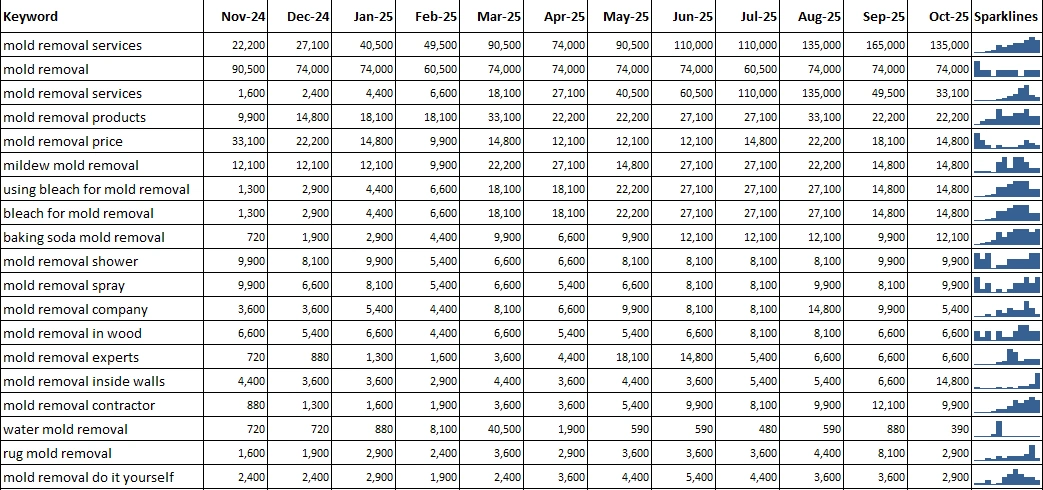
I don’t rely on "gut feelings" or black-box algorithms. Instead, I’ve programmed my tool to run a rigorous three-period time-series analysis (P1, P2, P3) over a 12-month window. By comparing the oldest period (P1) against the most recent one (P3) and ensuring monotonic growth in between (P2), my script identifies high-velocity opportunities with surgical precision.
I’ve engineered the system to flag four specific high-value statuses:
By isolating these signals, I help you move beyond "static" SEO. You get a prioritized list of keywords that your competitors who are likely using standard, slow-to-update tools haven’t even noticed yet.
My Keyword Clustering Tool is not a scraper, not a simple wrapper around an SEO API, and definitely not just another generic “keyword generator.”
I designed it as a full data-refinement and decision-making engine. By choosing this custom approach over off-the-shelf tools, you gain clear strategic advantages:
Whether you are a Marketer, SEO lead, or Media Buyer, my goal is to provide you with the data you need to make confident, data-driven decisions—without wasting a single hour on manual cleanup or questioning third-party metrics.
I built this system to solve a very specific, practical problem: how to generate a high-quality, reliable keyword dataset without the manual pain and endless noise. Today, this tool is the backbone of my workflow, and it has already successfully powered multiple SEO and PPC projects, delivering clarity where there was once only data chaos.
What sets this approach apart? A key advantage over tools like Google Trends is the level of granularity. While Google Trends shows you relative interest (0-100), my tool provides exact search volume figures.
We don’t just see the dynamics of a single query; we can compare multiple keywords and clusters against each other based on real frequency. This allows for data-driven prioritization that relative indexing simply can't support.
The result is a pipeline that delivers:
I am ready to apply this technology and my expertise to your next project. Whether you need deep niche research or a full-scale SEO strategy, I offer specialized services in:
My goal is to replace uncertainty with a predictable, repeatable, and scalable growth process for your business.
Contact me to discuss how we can turn your keyword data into a strategic asset.

 Upwork statistics
With 10+ years of experience and an engineering, user-oriented mindset, I help your business stay visible where it matters most. Whether it’s classic Google search, local search, or emerging AI-driven ecosystems like GEO (Generative Engine Optimization) and AEO (Answer Engine Optimization), I ensure your brand is the definitive answer to your customers' queries.
My track record is built on transparency and proven results. My clients' success and long-standing Upwork history stand as a testament to my reliability. I invite you to explore my portfolio and reviews—let’s connect and discuss how we can turn your data into a market-leading search presence.

Can the Keyword Clustering Tool be customized for local or niche businesses?

Absolutely. The tool is input-agnostic. Whether you provide a URL-based extraction of local competitors or a targeted seed list for a niche industry (e.g., mold remediation), the system filters data against client-specific stop-lists to ensure 100% commercial relevance to your specific territory.
How does your Keyword Clustering Tool differ from standard platforms like Ahrefs or Semrush?
Most SEO platforms provide estimated metrics based on clickstream data. My tool bypasses third-party guesswork by integrating directly with the Google Ads Data API. This ensures you receive first-party, real-time metrics for search volume and competition levels straight from the source.
How does the tool handle clustering for similar terms?
The system uses a multi-stage NLP normalization engine. By applying tokenization and lemmatization, the tool strips away grammatical noise and reduces keywords to their core semantic base. This ensures that phrases like "running shoes" and "shoes for running" are grouped into a single cluster, preventing content cannibalization.
What is the final output of the Keyword Clustering tool, and how do I use it?
Instead of a messy spreadsheet, you receive a clean, prioritized semantic roadmap. Each cluster is ranked by a composite score involving total volume, growth potential, and competition. You can immediately identify which content areas will deliver the highest ROI without any manual cleanup.
What are “Growth Signals” within the report?
I’ve engineered the system to flag four specific high-value statuses:

Submit a Request
If you would like to receive any additional information or ask a question, please use this contact form. I will try to respond to you as soon as possible.
Order a Service