Last year, while doing routine keyword research, I noticed something odd. Search volumes for colored gemstone jewelry had grown by multiples — not by a few percent, not seasonally, but by a factor of five to ten over twelve months. Every stone. Simultaneously. And the growth hadn't stopped.
I filed it away, meaning to come back to it. When I finally did, the data had only gotten more interesting.
Here is what the Google Ads API data shows for the U.S. market, monthly search volume, November 2024 through October 2025:
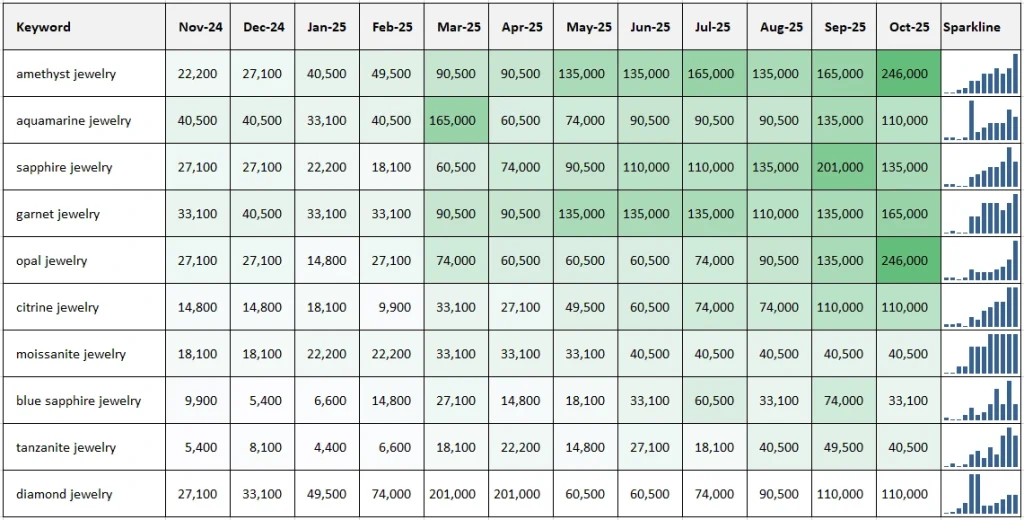
Year-on-year growth by keyword:
By contrast, moissanite jewelry — a synthetic diamond alternative — grew by roughly ×2. I will come back to that discrepancy.
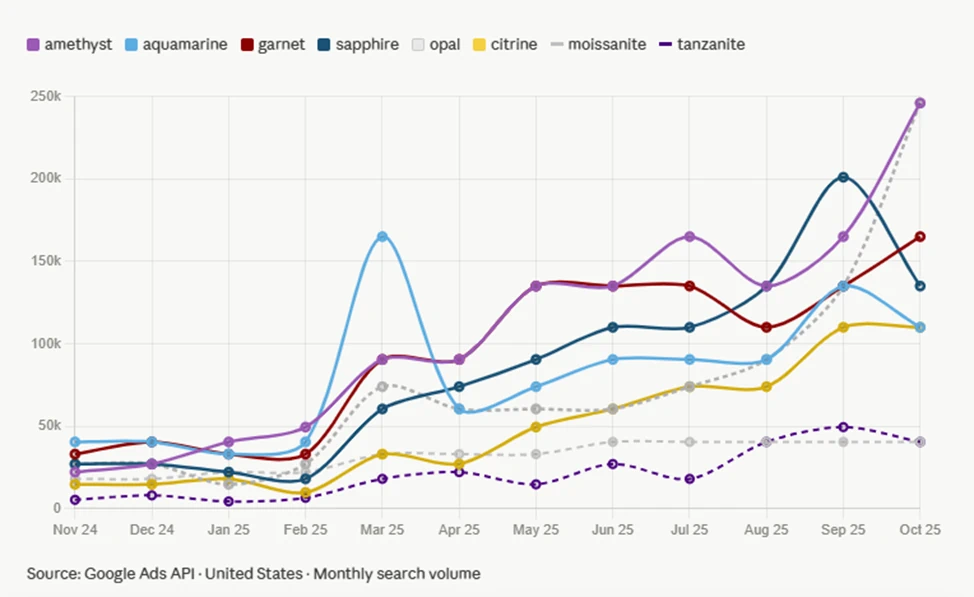
A few things stand out immediately.
Adding diamond jewelry to the chart makes the story considerably clearer.
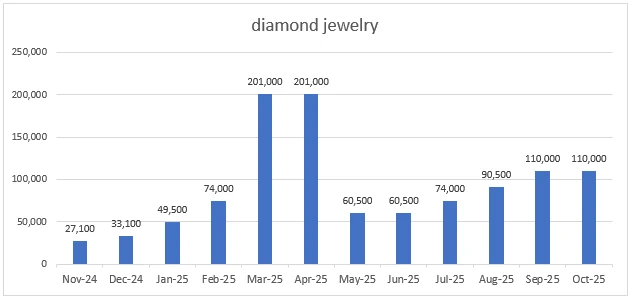
Diamond jewelry shows a sharp spike in March–April 2025 — peak engagement season in the U.S., when couples prepare for summer weddings — followed by a sharp fall back to baseline. Classic seasonal behavior: event-driven demand that arrives, peaks, and retreats.
Colored gemstones do something entirely different. They grow through March–April alongside diamonds, but when the seasonal demand fades, they do not fall. They take a new, higher baseline and continue climbing. The pattern is structurally different from anything that can be explained by seasonality or a single cultural moment.
Before looking at explanations, it is worth ruling some things out.
It is not a fashion trend in the traditional sense. Fashion trends spike and fade within a season or two. A trend that began in early 2025 and showed no reversal through late 2025 is operating on a different timescale. If a celebrity wore an amethyst ring at an awards show, we would expect a spike in that one stone — not a broad multi-month rise across the entire category.
It is not simply "alternatives to diamonds." This is where moissanite becomes the key data point. Moissanite is the canonical diamond alternative — colorless, cheaper, growing in popularity. If the trend were about moving away from diamonds toward substitutes, moissanite should have grown just as fast. It did not. Moissanite barely moved. Whatever is driving colored gemstone searches is specifically about colored stones, not about finding cheaper alternatives to diamonds in general.
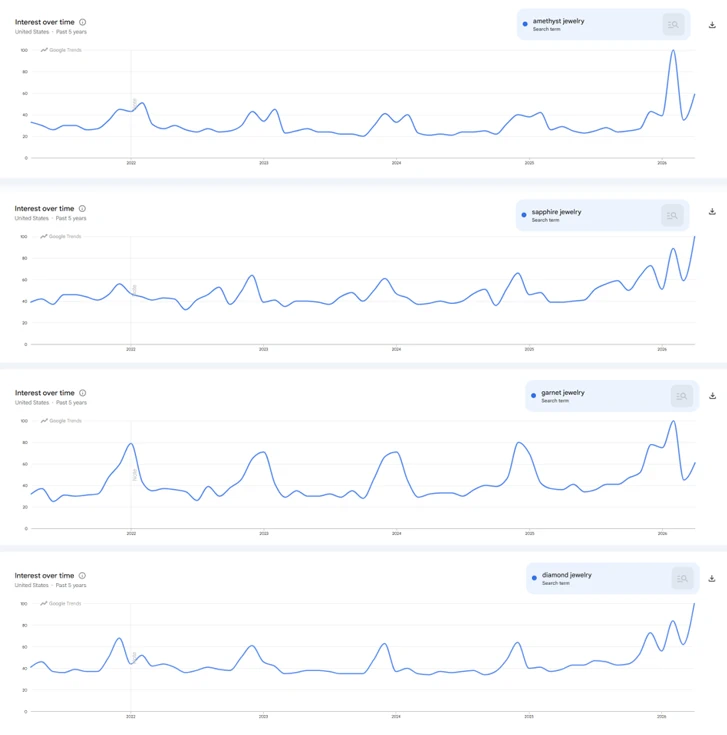
Here is the explanation I find most compelling, even though it still needs to be tested properly.
Gold prices rose dramatically through 2025 — from around $2,600 per ounce at the start of the year to over $3,500 by April, a 35% increase in a single quarter. That kind of move changes the economics of jewelry production in fundamental ways. Gold is not a commodity at the margins of a jewelry piece; it is often the primary cost driver.
Gold prices started rising in January 2025 — roughly six to eight weeks before the sustained uptick in gemstone search volume. That lag is exactly what you would expect if supply-side changes were driving demand-side behavior.
The mechanism, if this hypothesis is correct, would work something like this: gold price rises sharply → designers shift focus to stones and reduce metal weight to hold retail prices → assortments and marketing change → press and influencers pick up the new aesthetic → consumer search behavior follows with a delay of several weeks.
The consumer is not reacting to gold prices directly. Most consumers have no idea what gold costs per ounce. But the supply side does, and when designers and retailers change what they make and promote, search demand eventually follows.
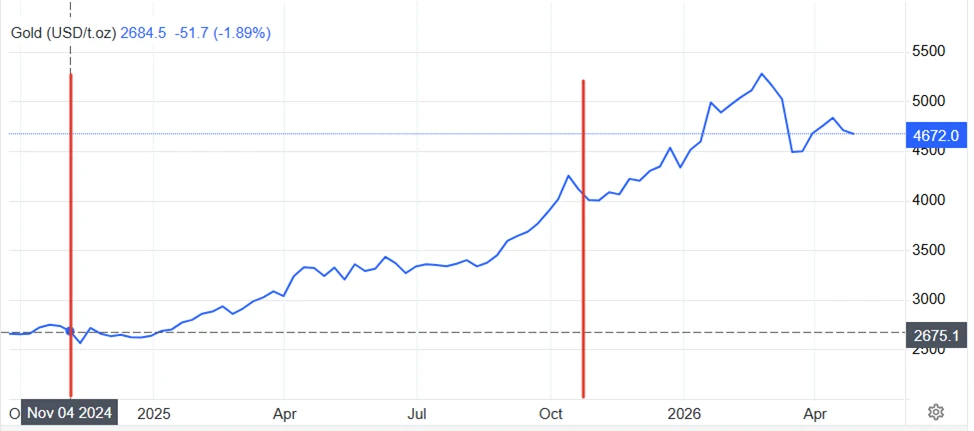
If the gold price hypothesis is correct, it also explains why the trend has been so sustained. Gold has not retreated to pre-2025 levels. The economics that pushed designers toward colored stones have remained in place. Every new collection, every campaign, every editorial feature reinforces the same direction. Consumer demand that was created does not simply disappear when the initial trigger is forgotten — it becomes self-reinforcing as the new aesthetic normalizes across the market.
This is different from a celebrity moment. A celebrity moment creates a spike but does not change the underlying supply of products being offered and marketed. A change in production economics does.
This is still a hypothesis, not a conclusion. Here is what would strengthen or weaken it:
Search volume measures intent, not behavior. People searching for amethyst jewelry are not the same as people buying amethyst jewelry. Some of this growth may reflect inspiration or curiosity rather than purchase intent. The full picture would require transaction data, average order values, and conversion rates — none of which are visible in keyword research.
What search volume does tell you, reliably, is that something changed in how consumers are thinking about this category. The question is whether that change was demand-led — consumers developed a new preference — or supply-led — producers changed what they offered, and consumers followed. The pattern here points toward supply-led, but that is still a hypothesis.
The intuition about consumer trends is that they flow from consumers: people decide they want something new, and the market responds. But often it runs the other way. Producers respond to input cost changes by pivoting their product mix, and consumer demand then adapts to what is available and marketed.
If that is what happened here, it is a reminder that keyword research is not just a tool for finding content opportunities. It is a window into the economics of an industry. A sudden, sustained, broad-based shift in search behavior almost always reflects something structural happening upstream — and understanding that structure tells you something more durable than any single trend report.
The gemstone jewelry data is a good example of why it is worth asking not just what is trending, but why — and whether the answer is sitting somewhere in a commodities chart rather than a TikTok feed.
Data source: Google Ads API, United States, monthly search volume. Keywords: amethyst, aquamarine, sapphire, garnet, opal, citrine, moissanite, blue sapphire, tanzanite, and diamond jewelry. Period: November 2024 – October 2025. Note: aquamarine peaks sharply in March due to its status as the March birthstone and is treated as a seasonal outlier separate from the broader trend.

 Upwork statistics
With 10+ years of experience and an engineering mindset, I help jewelry businesses capture demand where it is actually forming — not where it was last year. When colored gemstone searches grew 10x in 2025 while most brands were still optimizing for diamonds, my clients were already there.
Whether it's identifying emerging keyword categories before they peak, understanding how macroeconomic shifts like gold prices reshape consumer search behavior, or building content strategies that rank for what buyers are genuinely looking for — I connect the dots between market signals and organic visibility.
My approach is built on transparency and real data. I don't follow trend reports — I read the raw numbers and ask why. That's the difference between reacting to a trend and anticipating it.

How do you approach link building in a niche industry?

I focus on building relationships with niche-specific websites and influencers, creating highly relevant content, and using targeted outreach to earn valuable backlinks.
How do you handle duplicate content issues?
I use canonical tags, 301 redirects, and work to consolidate duplicate content into a single authoritative page to prevent any negative impact on rankings.
Why should I use SSL for expired (drop) domains?
If an expired domain previously used https, you must have an active SSL certificate to capture the link equity. Without SSL, browsers will block the connection, and search engines won't be able to follow the redirects from your old high-authority backlinks, effectively wasting the domain's SEO value.
What tools do you use for competitive research?
I use tools like SEMrush, Ahrefs, and Moz to gather detailed data on competitors’ SEO strategies, including keyword rankings, backlink profiles, and content performance.
What is your strategy for long-tail keywords?
I identify long-tail keywords that are highly specific to the target audience’s needs and incorporate them into content to capture more targeted and conversion-ready traffic.

Submit a Request
If you would like to receive any additional information or ask a question, please use this contact form. I will try to respond to you as soon as possible.
Order a Service